
Snap hooks
-
AuthorPosts
-
6 June 2023 at 17:24 #11111
Hello everyone. Can you give me some advice?
I have a trinquet with brass carabiners, which I need to rig on a loose textile prop. It’s very difficult, because the carabiners don’t slide on the textile stay and get stuck. I thought of replacing them with larger carabiners, also in brass, but I thought I’d ask those who have more experience with this sail.
Thank you for your understanding.
Milamar9 June 2023 at 19:42 #11114Hi Roberto,
On my Pogo 10.50, I had put textile carabiners, I found that the brass carabiners corroded, and sometimes snagged the sheath of the forestay during installation. I was happy with this, except that the installation wasn’t very easy. The carabiners chosen were probably a bit small. In practice, I installed the snap shackle in advance on the forestay, at the foot of the mast, and put it in place when needed, putting myself wide open so as not to get washed out…
Emmanuel
13 June 2023 at 22:40 #11142Reply from Xavier
“Advantages and conditions of use of a furler-mounted staysail;
The droppable forestay should be replaced by a moulded halyard that can be winched in.Simple: Double the pulley returns to ensure that all four GSE sheets and staysail are permanently in place. Put a circular line at the bottom of the furler, which will return under the hood. Great simplicity.
Order a special furler staysail with a high-tension luff and anti-UV tape.
X-RAY’s is laminated, but not essential.This staysail is designed to be constantly on station for long distance cruising.
If a lot of upwind tacking is to be expected, all you have to do is take the whole lower furler and sail to the foot of the mast without having to remove everything. Practical.
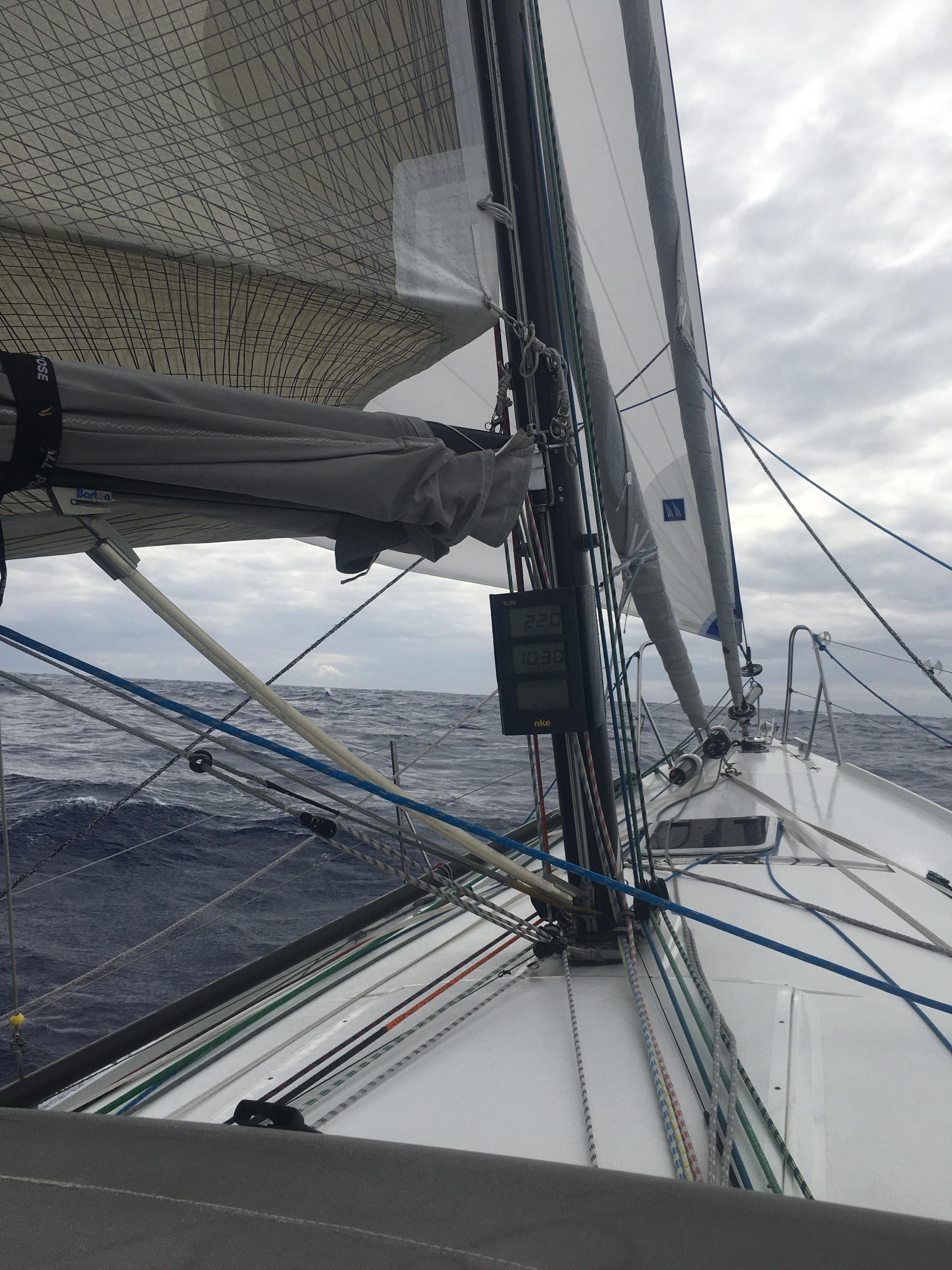 If, like me, you have to carry two staysail reefs for five days, you’ll really appreciate it.
This solution is ideal for a single-handed sailor, and has been a long time in the making, after not being satisfied first on an 8.50 and then on a 30 with these carabiners, which are dangerous to tie up at the bow in heavy seas.
Another significant advantage is that, from a certain angle onwards, the staysail can be used as an additional sail when reaching under gennaker, false code zero, assy and even symmetrical!
If this sounds surprising to you, I invite you to discover all these advantages during the upcoming October course on sail trimming with our undisputed specialist Benoît Hantzperg. Registration is now open…. Happy sailing X-RAY for AIP2 January 2024 at 13:45 #16228Hello everyone,
I’d like to add that once this system has been set up for the staysail, it can be used with a furling jib furler, using the furler on the staysail. This allows the furled jib furler to be set up in heavy weather and unfurled in calm conditions from the cockpit.
Have a good wind,
Lionel
2 January 2024 at 18:49 #16231Hello everyone, happy new year and good health to all.
Thank you for your interventions and the solutions you posted in response to my question. I solved it by replacing the old brass carabiners with steel ones from Wichard. It was the least expensive choice for me, and as I don’t sail much, I’ll probably adopt the same solution as Xavier in a few years’ time.
I love talking about that headsail!!!
When is it best to hoist it on the Pogo30 outside the conditions for which it is required?
Downwind under SPI or Gennaker? At which TWS?
Have a good wind3 January 2024 at 14:34 #16234Hello everyone,
Very interesting montage, thanks X-Ray.
Simplicity and security, a solution that suits me perfectly.
Quick question: is it necessary to reinforce the chainplate on an 8.50? I imagine the tension is high when you winch in the muffled halyard. If so, how do you go about it?
have a good wind.
-
AuthorPosts


- You must be logged in to reply to this topic.

